In today's manufacturing landscape, where flexible production and rapid delivery are increasingly emphasized, flatbed digital cutters are becoming a key choice for many businesses upgrading their production capabilities. Whether for packaging prototyping, advertising signage production, or precision processing of composite and flexible materials, these machines deliver high-efficiency, high-precision results that traditional manual methods struggle to achieve. So how exactly do they work? And why have they gained such rapid adoption across industries? This article will walk you through their operational logic step by step, from a practical production perspective.
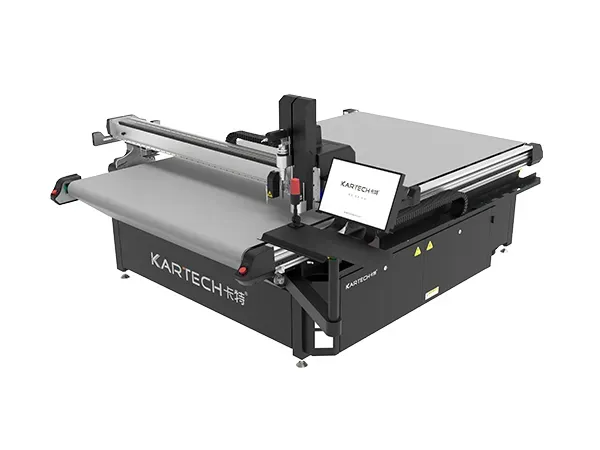
Simply put, a flatbed digital cutting machine is an intelligent cutting device that integrates CAD drafting with CNC machining. Centered around a “flatbed” structure, it employs interchangeable tools to cut, crease, slot, or make partial cuts on various materials. Eliminating the need for traditional molds, it excels at handling customized, high-variability processing demands, making it an essential tool for many businesses in sample prototyping and small-batch orders.
While equipment structures vary slightly by brand, the overall composition remains largely consistent. Each component determines whether the cutter can operate stably and efficiently.
1. CNC Control System
This serves as the command center. After importing CAD drawings, the system automatically generates cutting paths, assigns tools, calculates speeds, and continuously corrects positioning errors during processing. More advanced control systems deliver smoother, more precise cuts.
2. Platform Structure
Common types include honeycomb aluminum platforms and vacuum suction platforms. The honeycomb platform is sturdy yet lightweight, suitable for routine processing. The vacuum suction platform securely holds materials in place, serving as a key factor in ensuring cutting precision.
3. Multi-Tool Combination Tool Holder
The versatility of flatbed cutters across industries stems from their extensive tool selection, allowing flexible switching based on material type:
Vibrating Blade: Ideal for soft materials like corrugated cardboard, grayboard, and leather
Circular blade: Suitable for continuous materials like fabrics and industrial fibers
V-blade: Used for V-grooves in corrugated cardboard and honeycomb paperboard
Pressure wheel (creasing blade): Used for creasing lines on paper boxes
Kiss-cut blade: Primarily used for semi-cut processes on self-adhesive materials
In actual production, switching between blades often takes only seconds.
4. Drive System and Guide Rails
The servo system determines equipment stability and speed, while guide rail quality directly impacts smooth blade movement. A high-quality drive system enables high-speed displacement without vibration, resulting in clean, precise cutting edges.
5. Suction System or Pressure Roller System
Flexible materials commonly experience displacement issues. A suction system securely holds materials during processing, ensuring each cut lands precisely at the correct position.
To understand why this equipment is widely adopted, we must examine its processing workflow.
Step 1: Import Design Files
Operators import design files (AI, DXF, PDF, etc.) into the software, inspect cutting lines, fold lines, and bleed lines, and configure parameters based on material properties.
Step 2: Path Optimization
The software automatically sorts and optimizes cutting paths to minimize redundant movements and enhance processing efficiency. Though seemingly straightforward, this step significantly impacts overall processing time.
Step 3: Material Laying and Securing
Material is laid flat on the work platform, then secured using vacuum suction or pressure rollers. Strong adhesion prevents material shifting, ensuring cutting precision.
Step 4: Tool Selection and Calibration
The machine automatically selects the appropriate cutting head based on the task settings, configuring cutting depth and pressure. For multi-process tasks, the equipment sequentially performs actions like creasing and cutting.
Step 5: Cutting Execution
The cutting tool follows the predefined path, with the servo system maintaining stable speed and pressure. The oscillating blade vibrates at high speed to sever the material, the rotary blade rolls along the fiber direction, and the creasing wheel applies uniform pressure along the line—each action precisely controlled by the program.
Step 6: Finished Product Removal
After cutting, the finished product requires only minor trimming and no complex post-processing.
Compared to traditional die-cutting or manual material cutting, flatbed digital cutters offer significant advantages.
1. No Dies Required, Saving Time and Costs
Eliminates waiting for die production and avoids die costs. This is particularly crucial for packaging designs with frequent structural changes and sample cutting in the advertising industry.
2. Supports Multiple Materials and Processes
A single machine handles diverse materials like cardboard, leather, fabric, rubber, EVA, PVC, and epoxy boards, offering exceptional adaptability.
3. High Precision and Stability
CNC-driven systems ensure precise, controllable cutting paths; vacuum-assisted platforms minimize material movement; high-quality blades guarantee consistent results.
4. Ideal Solution for Small-Batch Orders
Today's industries increasingly demand “diverse varieties, small batches, and fast delivery”—flatbed cutters perfectly align with this trend.
5. High Automation Level
Optional features include CCD camera positioning, automatic feeding systems, and automated loading/unloading platforms, enabling effortless unmanned operation.
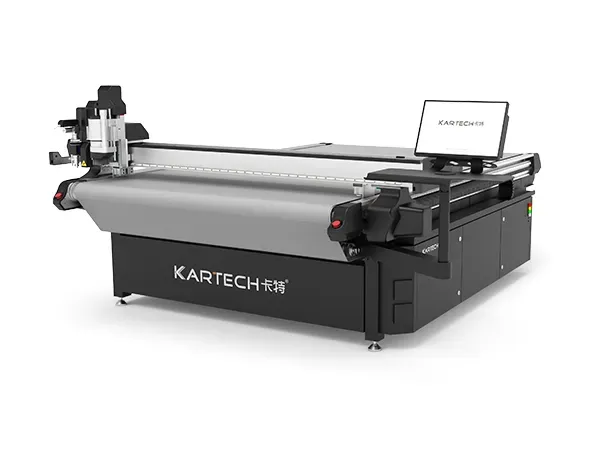
Flatbed digital cutting machines are applicable to nearly all flat material processing industries, such as:
Packaging Industry: Color box prototyping, small-batch production
Advertising Industry: Display board fabrication, visual display production
Furniture Industry: Fabric and leather cutting
Automotive Interiors: Door panel leather, cushioning material cutting
Aerospace & Composite Materials Industry: Carbon fiber cloth, fiberglass cloth
Electronics Industry: Processing insulating materials and cushioning gaskets
Its flexibility enables businesses to rapidly respond to customer demands and enhance overall production chain efficiency.
To maximize the equipment's value, pay attention to the following points:
Verify compatibility between primary cutting materials and cutting tools
Evaluate equipment precision, repeatability, and operating speed
Ensure platform dimensions align with production requirements
Evaluate software ease of use and feature completeness
Assess the professionalism and reliability of after-sales support
Verify compatibility with blade upgrades or expansion options
The right equipment not only boosts efficiency but also reduces long-term operational costs.
Though the working principle of flatbed digital cutting machines may seem complex, its core logic is straightforward: CNC control directs various cutting tools along preset paths on a flat platform, achieving high-precision, high-efficiency cutting. As more enterprises pursue flexible production, such equipment is becoming an indispensable part of modern manufacturing.
If you are considering upgrading your production processes, enhancing prototyping efficiency, or seeking a more stable and reliable material cutting solution, we welcome you to contact us. We will provide tailored recommendations and configuration plans based on your industry and material requirements.
Mass delivery and installation of KARTECH digital cutter XT-1625
2026-06-22FAYON & KARTECH Debut Full New Product Lineup at FESPA Global Print Expo 2026, Barcelona
2026-05-19Flatbed Digital Cutting Machine Troubleshooting Guide
2026-01-17Flatbed Digital Cutting Machine Operation Tutorial: A Practical Guide for First-Time Users
2026-01-17Address: Dingshang Street 21-6 Jindai Industrial Park, Guancheng District, Zhengzhou City
Email: info@fayontech.com
Phone: 0086 13213218088
0086 13213218088
Dingshang Street 21-6 Jindai Industrial Park, Guancheng District, Zhengzhou City